
Prevention-first glucose monitoring, built for primary care.
The Caddy is an investigational, truly non-invasive, wrist-worn glucose monitor designed to help clinicians support pre-diabetic and non-insulin-dependent adults — without needles, disposable sensors or a prescription.
Class II OTC · 510(k) planned
Sensing
Bioimpedance · no skin penetration
Intended population
Pre-diabetic & non-insulin-dependent
Quality system
ISO 13485 QMS
- Non-invasive bioimpedance
- Primary-care prevention
- Class II · OTC
- FDA 510(k) pathway
- CE · MDR / MDSAP
- ISO 13485 QMS
- HIPAA · GDPR · CCPA by design
- FHIR-compatible APIs
- Adult & pediatric roadmap
- Non-invasive bioimpedance
- Primary-care prevention
- Class II · OTC
- FDA 510(k) pathway
- CE · MDR / MDSAP
- ISO 13485 QMS
- HIPAA · GDPR · CCPA by design
- FHIR-compatible APIs
- Adult & pediatric roadmap
People worldwide estimated to be pre-diabetic.
Skin penetrations — sensors only touch the skin.
Planned OTC medical device (FDA & CE).
Designed for over-the-counter access, where authorized.

Prediabetes is detected in primary care — but rarely monitored.
Pre-diabetes is often asymptomatic, resulting in delayed recognition and missed opportunities for early intervention. Clinicians lack practical tools to monitor metabolic trends outside of episodic laboratory testing, and most patients receive little more than brief counseling.
There is a clear unmet clinical need for a solution that:
Enables early identification of pre-diabetes
Supports consistent, painless, and non-invasive monitoring
Is appropriate for both adult and pediatric populations
Is available without a prescription
Is supported by regulatory approval to ensure clinical trust
An OTC device that meets these criteria and is cleared in multiple major markets could empower general practitioners, patients and families to engage earlier in the care continuum — shifting from reactive disease management to preventive, data-informed intervention.
The Caddy: a truly non-invasive Class II wearable
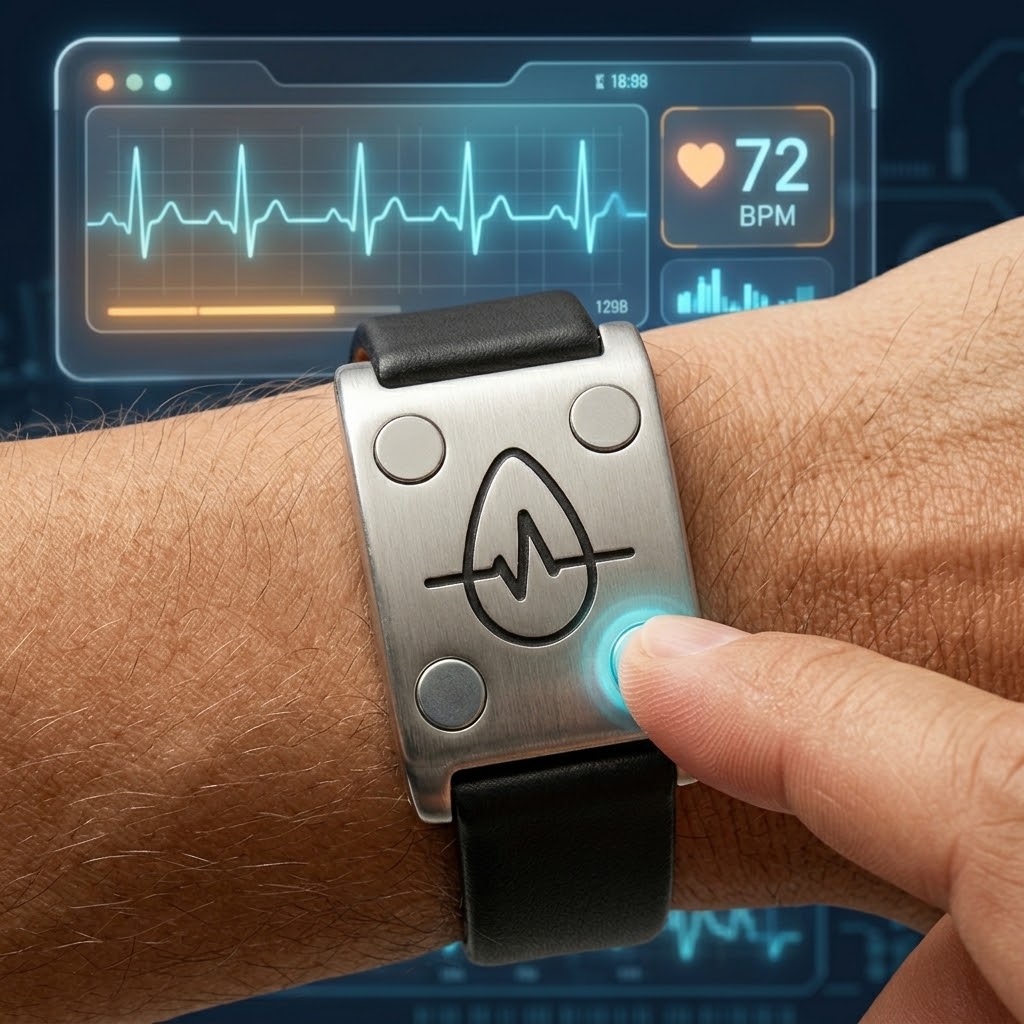
A wearable that fits on any standard watch band, communicates with a smartphone app, and uses WITO’s bioimpedance platform with cloud machine learning.

Touch
Patient touches two fingers to the top of the Caddy while it is on the wrist.
Bioimpedance signal
Encrypted signal is transmitted via the app to WITO’s cloud ingestion layer.
ML glucose score
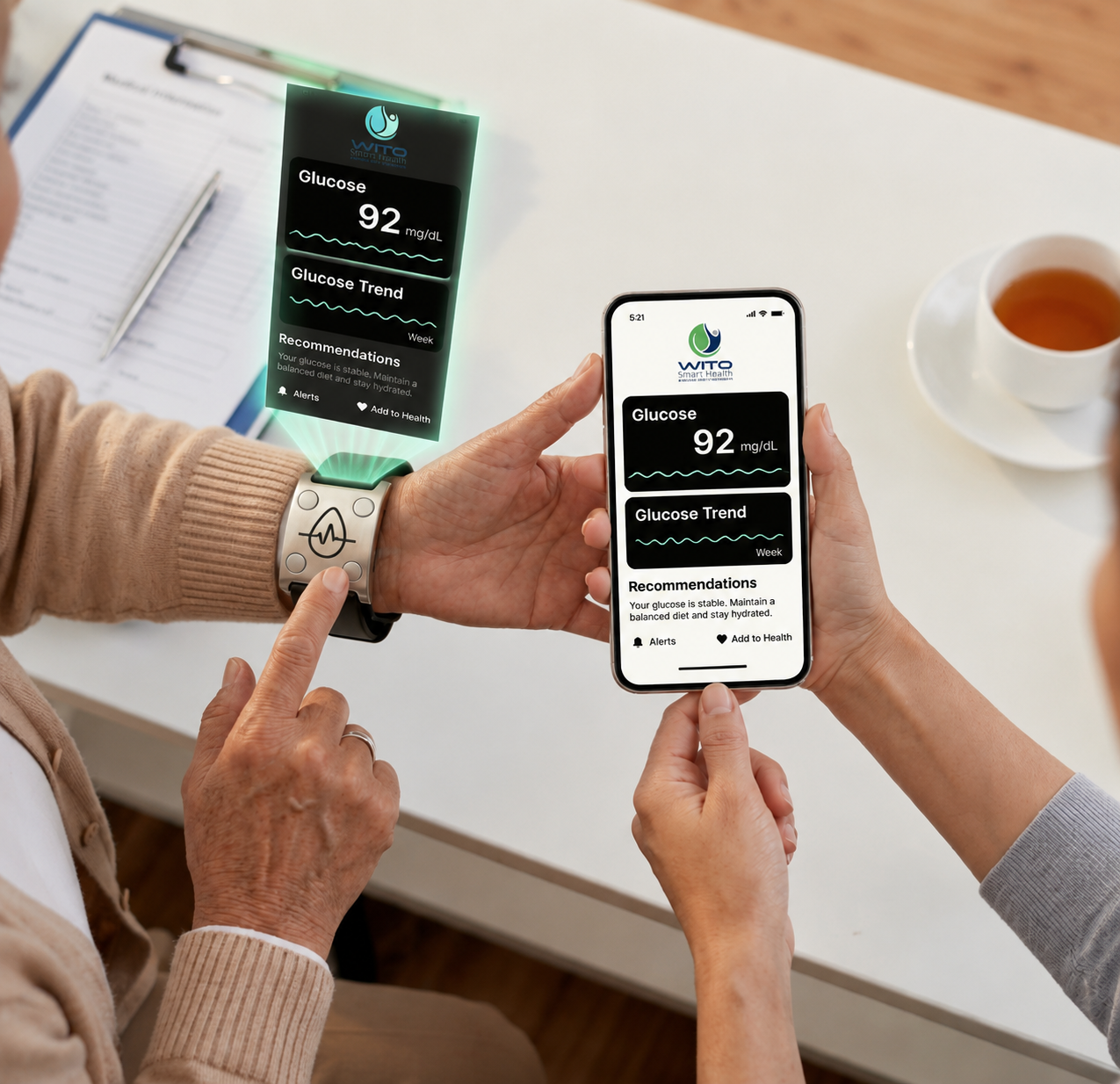
Validated models convert the signal to a glucose score shown in the app and portal.
Form factor
Flat 1 × 1 × ½-inch module on a standard ¾-inch spring-pin watch band
Sensing
Proprietary bioimpedance platform — sensors touch, never penetrate, the skin
Measurement
On-demand: user touches two fingers to the indicators on the device
Analysis
Cloud machine-learning / AI translates bioimpedance data into a glucose score
Connectivity
Encrypted Bluetooth to the WITO smartphone app
Power
Rechargeable — standard cable and wireless charging
Data sharing
Apple & Google health suites; secure sharing with physicians and caregivers
Consumables
None — no needles, patches or 10–15-day sensor replacement
Product images are illustrative company concepts; the final design may differ. Future biomarkers (e.g. hydration, cortisol, cholesterol) would require new algorithms and separate regulatory review.
Designed to inform the physician, not replace them
Proposed intended-use statement (subject to FDA and Notified Body review):
Class II · Over-the-counter (FDA & CE)
Pre-diabetic & non-insulin-dependent adults
Planned, subject to authorization & validation
A staged, evidence-first validation program
Phase 1 and Phase 2 are structured as observational protocols, conducted following the close of capital-raise activities, with clinical advisors and KOLs supporting study design.
Phase 1
Bioimpedance validation
Bioimpedance-only devices tested in a clinical setting against the hospital-based DEXA bioimpedance system (gold-standard control).
Phase 2
Glucose accuracy
Fully functioning prototypes evaluated against validated, certified hospital-based blood analyzers.
Design freeze
Technology transfer
Transfer to validated production lines; Phase 2 protocol repeated for process validation and publishable data.
Submission
FDA & CE data package
Data appropriate for FDA 510(k) and CE submissions. Pivotal studies not expected to be required given planned categories.
Key clinical endpoints
- Safety and ease of use
- Validated bioimpedance performance
- Clinically acceptable blood glucose measurements vs. analyzers
Development status
An early prototype has been bench-tested; the company reports glucose scores within about 1% of a standard glucometer. These are company-reported bench results only — not clinical data and not independently verified. Clinical performance will be established through the protocols above.
Regulated before launch — by design
Many consumer-marketed non-invasive products lack regulatory validation or clinical-grade reliability. WITO’s strategy prioritizes regulatory authorization prior to launch to support physician confidence and integration into formal care pathways.
FDA & CE class
FDA pathway
CE pathway
Quality
Planned regulatory timeline
Pre-submission
FDA pre-submission meeting (tentative, April 2026).
Submission
FDA and CE submissions planned after capital-raise tranches close.
FDA decision
Clearance expected ~4 months from submission.
CE mark
Expected ~8 months from submission under MDR/MDSAP.
Target markets: United States, Canada, Mexico and Brazil, followed by the EU. All timelines are company estimates and may change.
From risk identified to trends you can act on
General practitioners are typically the first to identify metabolic risk. The Caddy is designed to extend that moment into sustained, data-informed follow-up.
Identify
Metabolic risk identified at a routine visit, wellness exam or standard bloodwork.
Recommend
Clinician recommends the Caddy — obtained OTC, without prescription friction (where authorized).
Monitor
Patient takes on-demand readings; data flows to the WITO app and patient portal.
Share
Patient securely shares trends with their physician or caregiver.
Act
Clinician reviews trends at follow-up to guide lifestyle intervention and next steps.
Secure, clinician-ready data
A cloud-native platform purpose-built for regulated medical use: device signals are validated at ingestion, stored in specialized time-series and relational layers, and surfaced through the app, patient portal and provider dashboards.
Provider portal
Web-based dashboards for clinicians and care teams highlighting risk stratification, deteriorating trends and engagement metrics.
FHIR-compatible APIs
RESTful and, over time, FHIR-compatible APIs for EHR, payer and partner integrations.
Security & privacy
Encryption in transit and at rest, role-based access, full audit logging, tenant-level segregation.
Compliance by design
Aligned with HIPAA, GDPR and CCPA — consent management, retention controls, right-to-erasure.
Model governance
Version-controlled models, predefined acceptance criteria, drift & bias monitoring, documented rollback.
Population insights
Aggregated, anonymized analytics to quantify outcomes such as progression from pre-diabetes to Type 2.
Guided by clinicians
Eliot Jekowsky, Ph.D., M.D.
Chief Medical Officer
Clinician, physician executive and former medical director for Blue Cross Blue Shield of Massachusetts; experienced in designing clinical studies that meet FDA requirements and medical necessity criteria for payers.
Ajay Rao, MD, MMSc
Advisory Board
Temple University Hospital.
Patrick Hanley, MD
Advisory Board
Nemours Children’s Hospital.
Key Opinion Leaders
Clinical advisors
Three KOL advisors contracted to support technology strategy, clinical protocol design and introductions to additional KOLs.
Engineering partner: Andrews-Cooper, a medical-device specialty engineering firm with 200 in-house engineers. Preferred manufacturing candidate: OES Technologies (no agreement executed).
Questions from clinicians
Need something more specific? Request clinical information and our medical team will follow up.
Is the Caddy cleared by the FDA?
No. The Caddy is investigational. WITO plans to seek FDA clearance as a Class II OTC device through the 510(k) pathway, and CE marking under MDR/MDSAP.
Can I recommend or prescribe it to patients today?
Not yet — the device is not available for clinical use or sale. Join the HCP Network to receive updates on clinical studies and availability.
What accuracy data exists?
Only company-reported bench data from an early prototype (about 1% vs. a standard glucometer). It is not clinical data and has not been independently verified. Clinical accuracy will be established in Phase 2 against hospital blood analyzers.
How does it measure glucose without penetrating the skin?
Sensors on the device touch the skin and capture a bioimpedance signal; WITO’s cloud machine-learning models are designed to translate that signal into a glucose score.
Which patients is it intended for?
Pre-diabetic and non-insulin-dependent consumers, used to monitor and record glucose to inform their physicians. Pediatric use is planned subject to authorization and clinical validation.
Will it integrate with EHRs?
The platform is being designed with RESTful and, over time, FHIR-compatible APIs to support EHR and partner integrations, alongside a provider portal.
How is patient data protected?
Encryption in transit and at rest, role-based access controls, full audit logging and tenant-level segregation, aligned with HIPAA, GDPR and CCPA.
Help shape prevention-first glucose care.
WITO is building a network of physicians, nurse practitioners, dietitians, diabetes educators and researchers interested in preventive glucose monitoring.
- Early access to clinical study updates
- Product demonstrations as prototypes mature
- Opportunities to inform protocols & usability
- Clinically responsible educational materials